
Predictable freight, built around your network.
Every shipper runs its own bid cycle, and they all land on you. Leaf gives you one picture of your network, so every RFP, award and tender is a decision about balance rather than a scramble.
Ask your network anything.
Leaf's AI agent lives right inside Leaf and sees what you're working on. Ask it what you'd ask your best analyst: it works through your network and your shippers' bids with Leaf's scoring, then answers in plain language, with the numbers and what's behind them.
- Plain-language questions. Which lanes to bid on and why, which markets an RFP helps balance, where your network is most out of balance over the last 90 days.
- Answers you can use. Tables, charts and maps you can open, copy or download, and it takes you straight to the page in Leaf.
- It does the legwork. Drop in an award file and it models what the award does to your flows and balance, finds the return freight in bids you already hold, and drafts and prices packages for your review.
- You stay in control. Nothing reaches a shipper without your approval. It sees only the data you've chosen to share, and every figure traces back to its source.
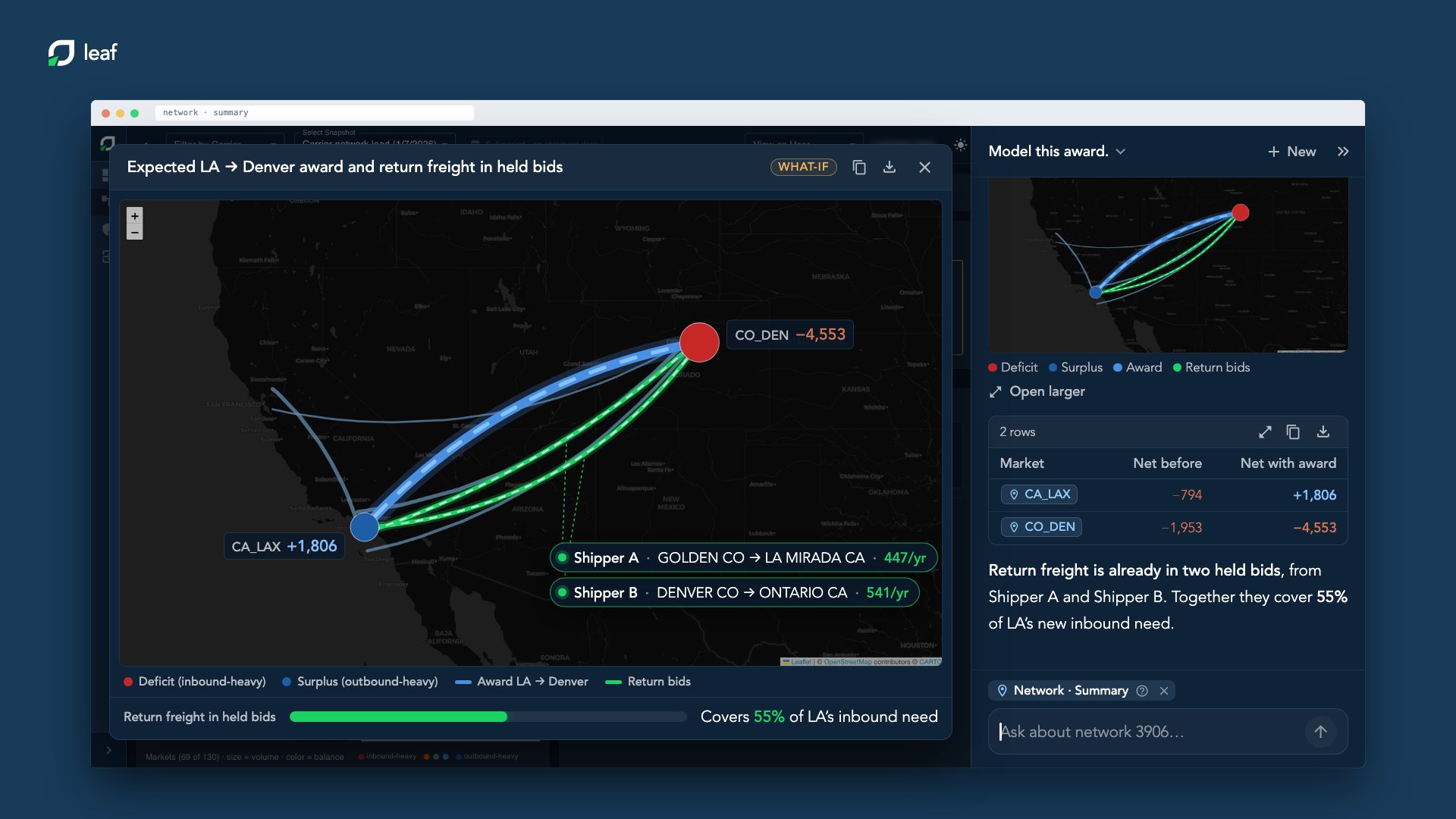 Leaf's AI agent · 1:46
Tame the chaos of many shippers' cycles.
Four things a carrier needs to know, in one place, kept current from your own dispatch data.
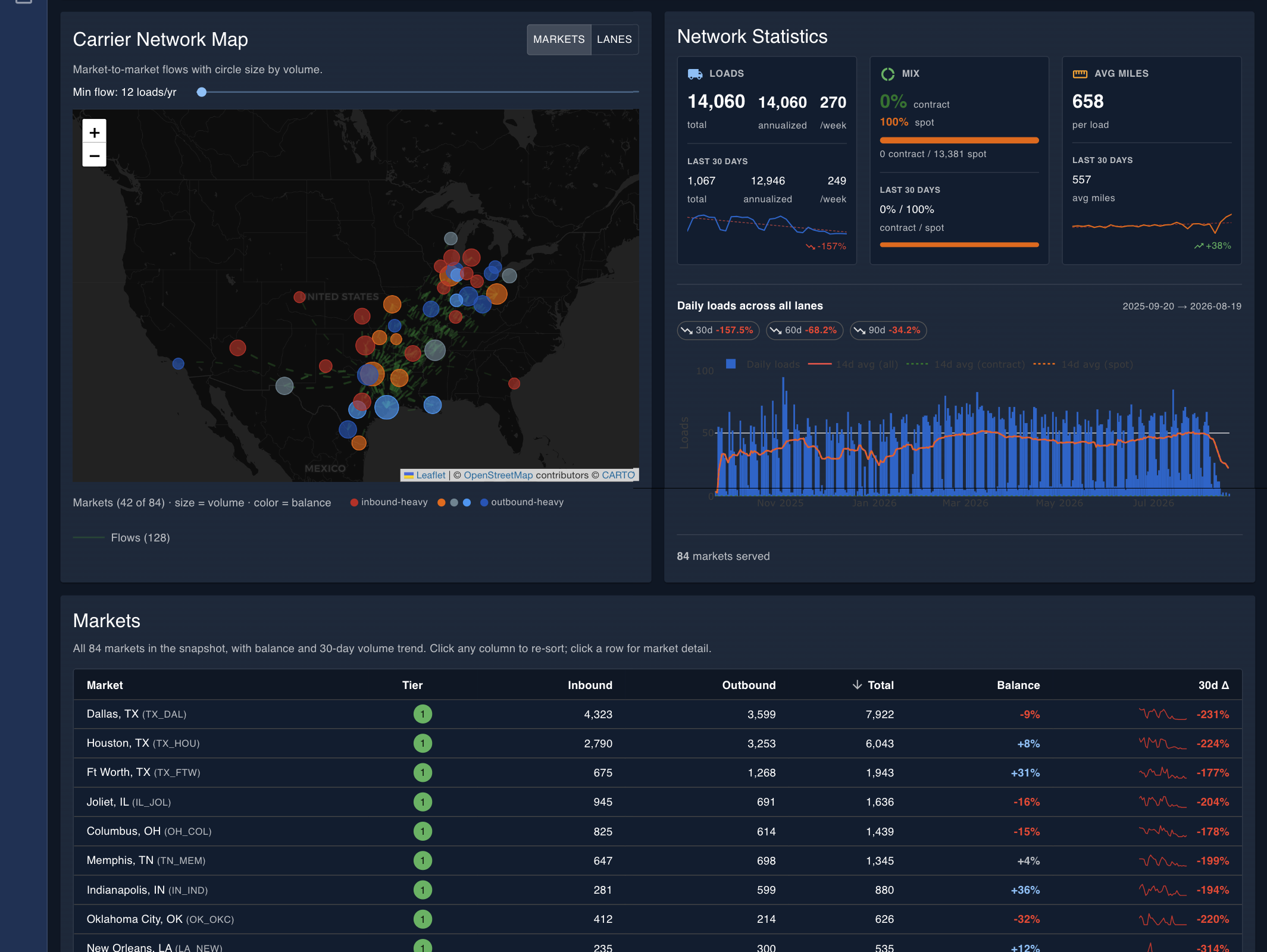
Know where your network stands, and where it's heading
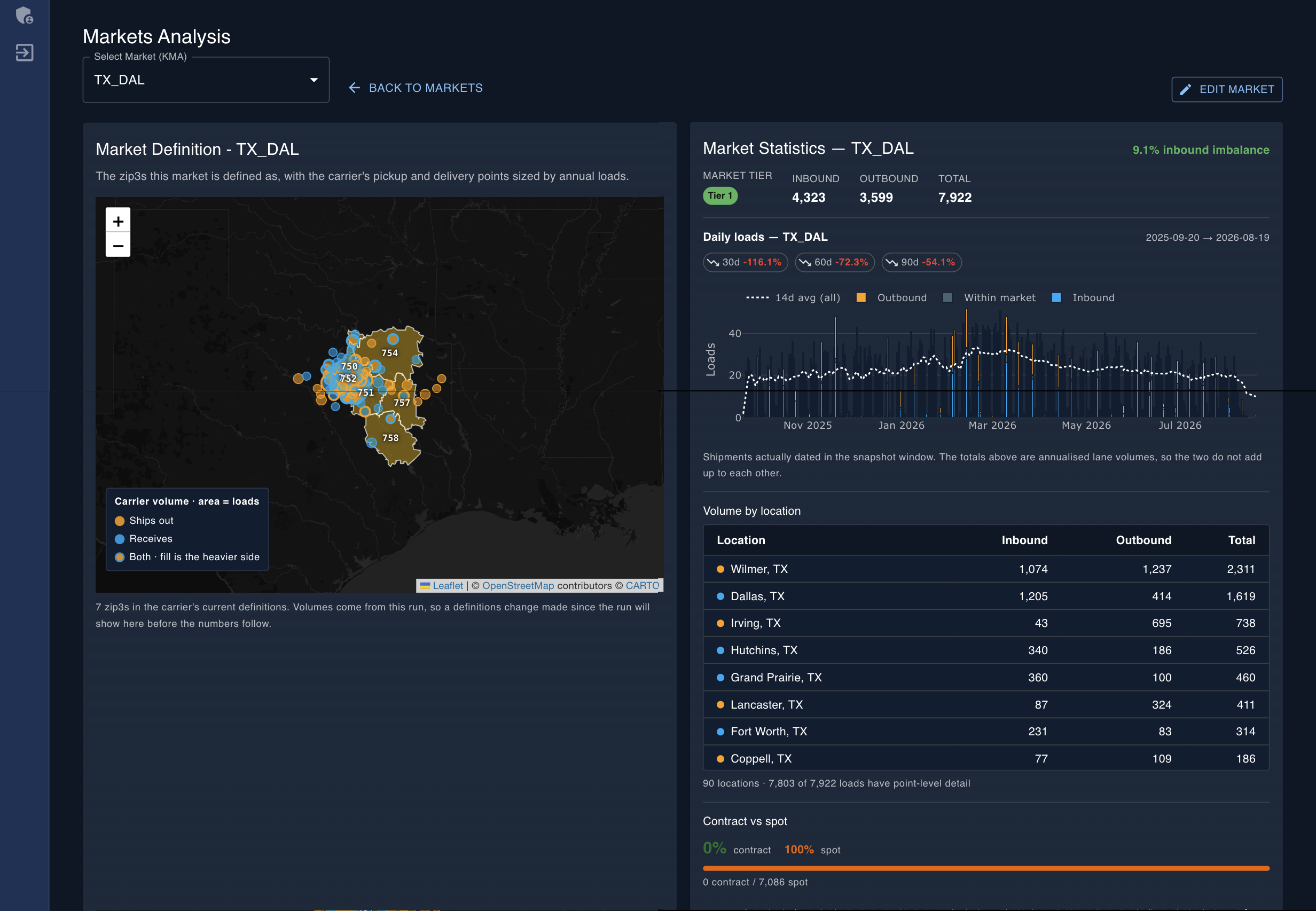
Which markets are in balance, which pile up trucks, which send them out empty, and how that changes as freight shifts. See what a pending RFP award does to your balance before you accept it.
- Every market scored for balance and 30-day trend
- Pickup and delivery points, inbound and outbound, by location
- What-if: apply an award and watch the balance move
Bid on what fits, singly or as a package
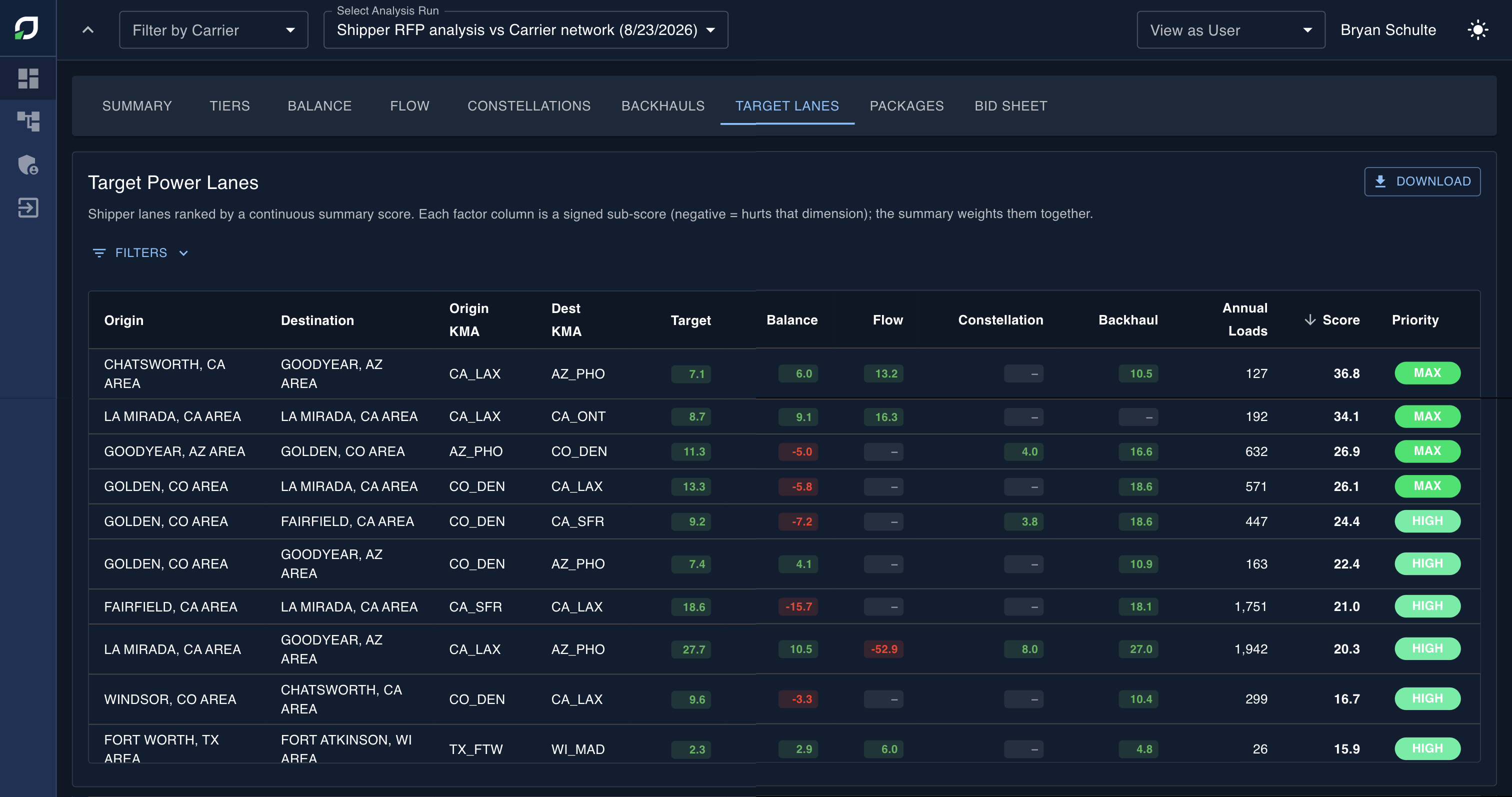
When a shipper's RFP arrives, Leaf scores every lane for fit with your network in minutes, then finds the constellations of correlated lanes you can propose as one package, with the predictability of dedicated freight and higher utilization than any lane-by-lane award.
- Every lane scored on target market, balance, flow, constellation and backhaul
- Packages built from lanes that complete your circuits
- Bid sheets exported with the package priced as one
Fill emerging imbalances before the next bid season
Balance drifts between RFPs: an award ramps, a customer's volume moves, a market goes lopsided. Leaf watches for it and finds shipper volume that solves it, as single lanes or, better, as packages you can take to a shipper before their next RFP.
- Which imbalances an award creates or worsens
- Which shipper lanes or packages fix them, and how much
- Where to look for net-new volume
Front Range loop
18 loads / wk- Denver → Phoenixshipper lane
- Phoenix → Los Angelesyour freight
- Los Angeles → Denvershipper lane
Tulsa backhaul
12 loads / wk- Windsor, CO → Tulsayour freight
- Tulsa → Dallasshipper lane
- Dallas → Denvershipper lane
Mountain triangle
9 loads / wk- Salt Lake City → Denvershipper lane
- Denver → Las Vegasshipper lane
- Las Vegas → Salt Lake Cityyour freight
Watch the awards you win, load by load
Once a package is live, Adapt tracks it: where volume is running above or below the award, where a shipper's tender volatility makes them hard to serve, and where the plan needs to be re-cut. You see it monthly; the shipper sees the same picture.
Awarded lanes vs. plan, last 12 weeks
loads per week · plan shown as the lineCarriers across the country.
“We’ve been working with Leaf since 2018, enhancing service to our customers and increasing predictability for our carrier partners. Using Leaf as a “logic layer”, we plan to further automate transportation decision making, systematically reducing manual effort and eliminating empty miles across our network as we work towards our goal of a carbon-neutral supply chain.”
What to expect.
Is Leaf a broker?
What do you need from us?
Do we still have to run RFPs?
Which shippers can we see?
Bring your network to Leaf. It takes one dispatch extract.
We'll build your digital twin and show you what it finds, including what your next RFP award would do to your balance.
Talk to Leaf